

Woke up this morning and the world had changed again.
TL;DR
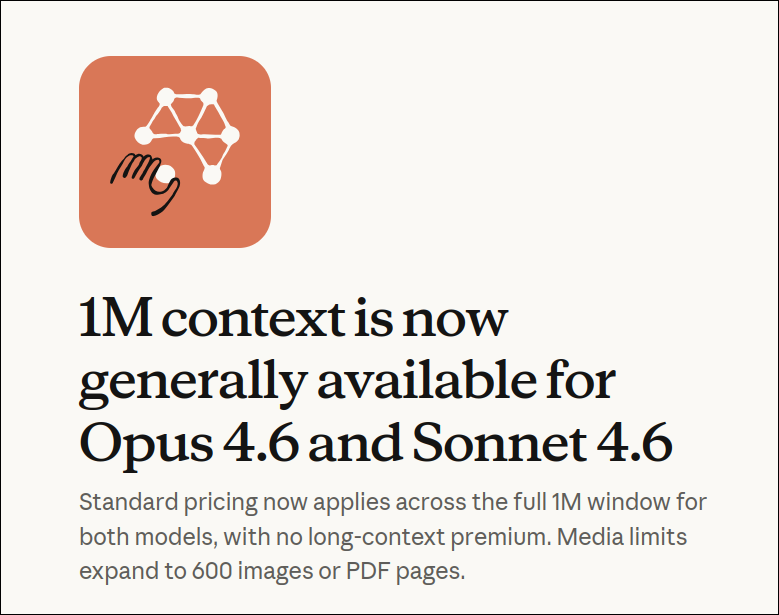
- Claude Opus 4.6 & Sonnet 4.6: default context window is now 1M tokens (~750K words)
- No extra cost — per-token pricing stays the same whether you use 9K or 900K tokens
- No beta header required — the technical barrier is completely gone
- Media: increased from 100 → 600 images/PDF pages per request
- Claude Code (Max/Team/Enterprise): full 1M context with less compaction
- Opus 4.6 scores 78.3% on MRCR v2 — the highest among frontier models
The Good News
Anthropic has officially opened up the 1M context window to regular users. Previously, if you wanted 1M context via the API, you had to be on Tier 4 (requiring $400 in usage) and manually add a beta header to every single request. That’s all gone now — 1M is the default, with no extra fees and no special headers needed.
Per-token pricing hasn’t changed either. A request using 900K tokens costs exactly the same per token as one using 9K. There’s no “more context = more expensive” penalty anymore.
On top of that, the media limit has been bumped from 100 to 600 images/PDF pages per request — a 6x increase. Great news for anyone working with lengthy documents, scanned PDFs, or batch image processing.
For Claude Code users (Max, Team, Enterprise), the full 1M context window is now fully utilized. Longer conversations, less compaction, better context retention across extended coding sessions.
The Not-So-Good News
Remember that full AI landscape roundup from February? Hallucinating agents, context windows, the whole picture — the 1M context era has quietly been creeping into the mainstream. Gemini opened up 1M context first, then Claude Sonnet 4.6 followed, then GPT 5.4 came in with 2M.
What would 10M context even look like? And then 100M? How terrifying would that get?
— from that AI landscape post
And honestly, Anthropic, Google, and OpenAI are still holding plenty of cards close to their chests. Nobody leads with their ace in a real fight. We have no idea how far along their actual model research really is. There are a lot of unrevealed plays still to come — the future remains deeply uncertain.
As context windows keep growing, AI isn’t just “reading” a single code file or a single doc page anymore. It reads your entire codebase, your full documentation suite, your complete conversation history — and it remembers all of it. That sounds convenient, and it is. But it also means AI is increasingly capable of doing things that used to require a human to sit down, read, understand, and synthesize.
Who Benefits?
Product people will definitely move faster. You can now dump an entire PRD, wireframes, API docs, and the current codebase into a single context and just say: “Got all that? Now build it.” No more chunking things up, no more summarizing, no more “read this file first and I’ll send the next one.”
Anyone already on Claude’s Max, Team, or Enterprise subscription plans will start working faster too. Smoother workflows, fewer context interruptions.
In short, if you use AI, you win.
Who Gets the Short End of the Stick?
Developers. Mostly developers.
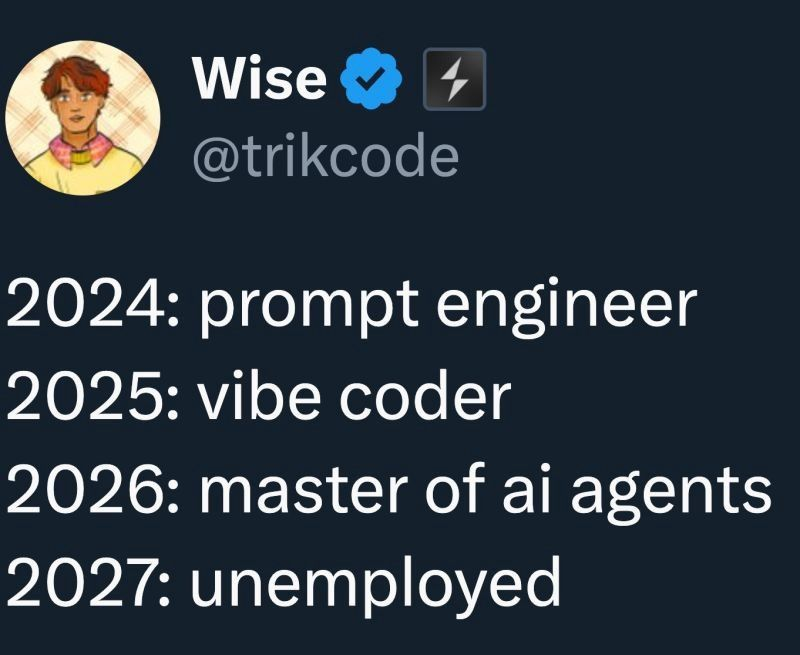
As expectations keep climbing, the perceived value of a developer’s work gets quietly devalued — because AI’s presence makes people expect us to be 10x engineers. And when 10x Engineer becomes the new baseline, the very definition of “good enough” shifts upward with it. The pressure on us just keeps growing.
Employers now have thousands of options, while workers have fewer. We used to compete against other people to survive. Now we’re competing against people and AI — something that doesn’t sleep, doesn’t take PTO, and can now hold 1 million tokens in a single glance.

If you enjoy this kind of “hopeless but still trying” content, feel free to follow me. Or just stick around so that whenever a new AI model or tool drops and you somehow miss it, at least there’s someone here to write it all up for you.

Comments
Join the conversation
Leave a comment
No comments yet
Be the first to share your thoughts!